October 8, 2026
Travel Lead Management: Capture, Assign and Track Enquiries
Travel lead management systems capture, route and track every enquiry through your pipeline. Learn how Indian agencies close more leads with less chaos.
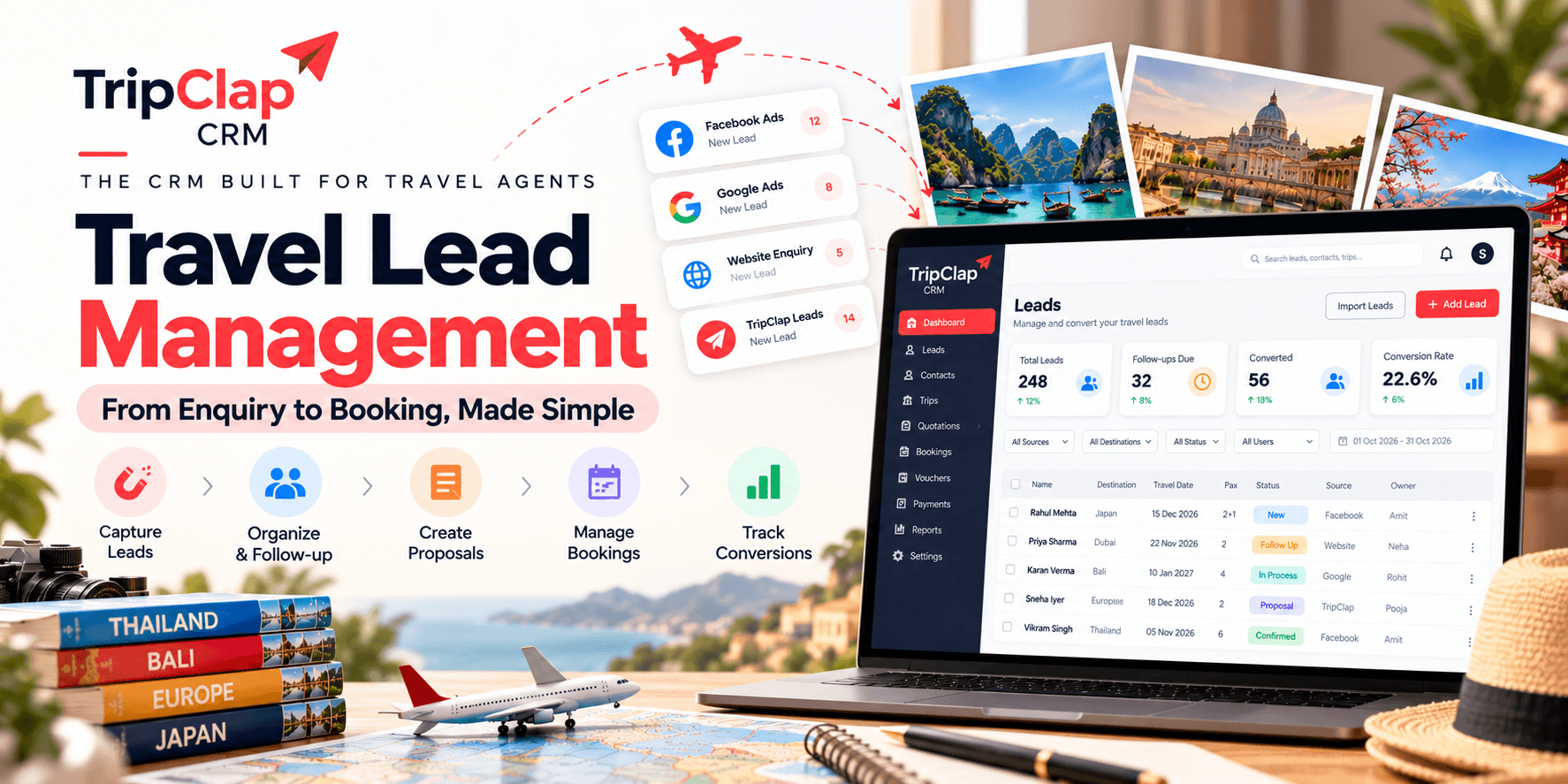
Short answer: Travel lead management means capturing every enquiry from all sources, assigning it to the right person, tracking it through a clear pipeline, and following up until it closes or dies. The agencies that convert more do three things: respond within minutes, never lose a lead, and know exactly where each enquiry stands.
The enquiry came in on WhatsApp. Someone replied. Then nothing. No record, no reminder, no one accountable. Three weeks later the customer books somewhere else.
This is not about having too few leads. It is about having no system to manage the leads you already get. When you run a travel business across WhatsApp chats, Excel sheets and Gmail, enquiries can fall through the cracks. The agencies that grow put every single enquiry into one place, route it to the right person, and track it until it closes.
Here is how to build a travel lead management system that actually works.
Where travel leads come from
Indian travel agencies get leads from at least seven or eight places. If you are not capturing all of them in one system, you are already losing enquiries.
Facebook Lead Ads. You run an ad for a Kashmir package. Someone taps "Get Quote". Facebook collects their name, phone and email. If you do not have automatic import set up, you download a spreadsheet every few hours and type the leads into your CRM or Excel. By then, half of them have gone cold.
Google Ads lead forms. Same story. Someone searches "Bali tour package", clicks your ad, fills the form. Google holds the lead. You need to pull it into your system within minutes or the enquiry is wasted.
Website contact forms. A customer fills your "Plan My Trip" form at 11 PM. If no one replies until 10 AM the next day, they have already contacted three other agencies.
TripClap marketplace leads. If you list packages on TripClap.com, you get enquiries from travellers browsing the marketplace. These come with the customer's trip dates, destination and budget already filled in.
WhatsApp. A friend forwards your number. Someone asks "Do you do Thailand?". If you reply on WhatsApp but never move the enquiry into your CRM, you will forget to follow up.
Walk-ins and phone calls. A customer walks into your office or calls your landline. Your front-desk person writes the details on paper. The paper sits on someone's desk for two days.
Referrals. A past customer refers their colleague. You get an email introduction. It sits in your inbox until you remember to reply.
Typeform and other survey tools. Some agencies use Typeform to collect detailed trip preferences. If Typeform is not connected to your CRM, you are copying and pasting leads manually.
Every one of these sources needs to feed into one central system. That is what travel lead management means.
A standard pipeline for travel enquiries
Once a lead is in your system, it moves through stages. Most travel agencies use some version of this four-stage pipeline.
| Stage | What it means | Typical action |
|---|---|---|
| New | Enquiry just came in, not yet contacted | First response within 5 minutes |
| In-process | Quotation sent, waiting for customer reply | Follow up every 2–3 days |
| Follow Up | Customer interested but not ready to book yet | Set a reminder for a week or the travel date |
| Matured | Booking confirmed, advance received | Move to operations, issue voucher |
Some agencies add a fifth stage called Dropped or Lost. When you mark a lead as lost, your CRM should ask why: budget too high, went with another agency, trip cancelled, no response. This data tells you where your sales process is breaking.
The pipeline is not complicated. What matters is that everyone on your team uses the same stages and updates them honestly. If your sales manager looks at the pipeline and sees 40 leads stuck in "In-process" for three weeks, that is a red flag.
Response time: the one metric that predicts conversion
I will be blunt. Replying quickly to travel enquiries improves conversion rates.
Travellers today are comparison shopping. They send the same enquiry to five agencies on Google. Fast response time improves your chances of winning the booking.
Here is what I see agencies doing:
- Reply within 2 to 5 minutes with a holding message: "Thanks for your enquiry, I am checking availability and will send you a detailed plan in 30 minutes."
- Send the actual quotation within 2 hours if the trip is standard. Within 24 hours if it is complex.
- If you cannot meet these timelines, you need more people or better tools.
This is where automatic lead capture matters. If your Facebook leads flow into your travel CRM automatically and get assigned to a salesperson instantly, that person can reply from their phone within minutes. If the leads sit in a spreadsheet waiting for someone to notice them, you have already lost.
Duplicate leads and how to handle them
The same customer fills your website form, then calls you, then sends a WhatsApp message. Now you have three leads for one person. If two salespeople reply, you look disorganised. If no one replies because each person thinks the other person is handling it, you lose the booking.
A proper travel enquiry management system catches duplicates. It matches phone numbers and email addresses. When a duplicate comes in, it either merges the new enquiry into the existing contact or alerts you so you can decide.
TripClap CRM does this automatically. If the same phone number or email appears twice, the system flags it and asks if you want to merge or keep separate. Most of the time you merge. Occasionally you keep separate, like when a corporate travel manager enquires for two different groups.
Auto-capture and auto-assignment in TripClap CRM
Let me walk through how this works in practice. I run TripClap CRM, so I will be open about that, but I will also tell you where we fall short.
Auto-capture. You connect your Facebook Lead Ads account once. After that, every lead from Facebook flows into TripClap CRM within 60 seconds. Same for Google Ads lead forms. Website forms post directly via webhook or Zapier. TripClap marketplace leads appear instantly because the CRM and the marketplace share the same backend. Typeform connects with one click. For WhatsApp and walk-ins, your team adds the lead manually in under 30 seconds using the mobile app.
Auto-assignment. You set rules. For example, all Facebook leads for Kerala go to Ramesh. All TripClap leads for international packages go to Priya. All website leads get assigned round-robin across your three salespeople. The system assigns the lead the moment it arrives and sends a notification to that person's phone. They get a push alert, open the app, see the customer's name, destination, dates and budget, and reply immediately.
Auto-assignment fixes that. Someone is always accountable.
Where TripClap CRM falls short
TripClap CRM does not have a built-in phone dialler or call recording. If your team makes 50 outbound calls a day and you want call logs and recordings inside the CRM, you will need to integrate a separate telephony tool or track calls manually. We focused on the enquiry-to-quotation workflow instead, because that is where most Indian agencies were bleeding leads.
Daily routine for a travel sales manager
If you manage a sales team, here is what your morning should look like.
9:00 AM: Open your CRM dashboard. See how many new leads came in overnight. Check if anyone has a follow-up reminder for today. Look at the pipeline: how many leads are in each stage, and are any of them stuck.
9:15 AM: Review yesterday's activity. Did every new lead get a first response within 10 minutes? Did anyone move a lead to "Matured" or "Lost"? If a lead was marked lost, read the reason.
9:30 AM: Check response times. Most travel CRMs show you the time between lead creation and first reply. If someone is consistently taking 2 hours to respond, talk to them. Either they are overloaded or they are not checking their phone.
10:00 AM: Follow-up sweep. Look at all leads in "Follow Up" stage. If the customer said "I will decide next week" and next week is today, call them. Do not wait for them to call you.
11:00 AM: Pipeline review with the team. Twice a week, pull the team together for 15 minutes. Go through the "In-process" column. Ask: what is blocking this lead from moving forward? Do we need to revise the quotation? Is the customer waiting for us or are we waiting for them?
This routine takes 90 minutes a day.
Lead source tracking and what it tells you
Your CRM should tag every lead with its source. Then you run a report at the end of the month and see this:
| Source | Leads | Bookings | Conversion rate | Revenue |
|---|---|---|---|---|
| Facebook Lead Ads | 120 | 18 | 15% | ₹8.4 lakh |
| TripClap marketplace | 45 | 12 | 27% | ₹6.2 lakh |
| Website | 30 | 6 | 20% | ₹4.1 lakh |
| Referrals | 15 | 9 | 60% | ₹5.8 lakh |
| Walk-ins | 10 | 4 | 40% | ₹2.2 lakh |
This tells you where to spend your marketing budget. Referrals convert at 60 per cent but you only get 15 a month. Can you ask for more referrals? TripClap marketplace leads convert at 27 per cent. Can you list more packages there? Facebook gives you volume but lower conversion. Can you tighten your targeting or improve your first response?
Without source tracking, you are flying blind. You know you got 220 leads last month, but you do not know which channels are worth your time.
Using the AI Assistant to manage your pipeline faster
TripClap CRM has an AI Assistant that you can ask questions in plain English, Hindi or Hinglish. I use it every day. Here are some examples:
- "Show my new leads from yesterday." It lists them with source, destination and assigned salesperson.
- "Who departs in the next 7 days?" It pulls the departure calendar and shows confirmed bookings.
- "List unpaid invoices." It gives you every booking with an outstanding balance, sorted by due date.
- "Draft a follow-up message for Ramesh Kumar." It reads the lead history and writes a WhatsApp message you can edit and send.
The AI is not replacing your sales team. It is making them faster. Instead of clicking through five screens to find a piece of information, you ask a question and get an answer in 3 seconds.
What happens when a lead matures
A lead moves to "Matured" when the customer pays the advance and confirms the booking. At that point, lead management ends and operations begins.
Your CRM should automatically:
- Create a booking record with the customer's travel dates, package details and payment schedule.
- Add the departure to your calendar.
- Notify your operations team so they can start booking hotels and transport.
- Generate a voucher and a GST invoice.
In TripClap CRM, when you mark a lead as matured, the system asks for the booking amount and the advance received. It creates a payment ledger, syncs the departure to your Google Calendar, and moves the customer into the "Bookings" section. From there, your operations team can assign cabs, upload vouchers, and track the trip through departure.
The entire flow from enquiry to departure stays in one system. That is what a proper travel CRM software guide should show you.
Checklist: does your lead management system do these 10 things?
Here is how to audit your current setup. If you answer "no" to more than three of these, you need a better system.
- Every lead from every source lands in one place within 5 minutes.
- Each lead is automatically assigned to a specific person who gets a notification.
- You can see the pipeline at a glance: how many leads in each stage, and who owns them.
- The system catches duplicate phone numbers and emails before you reply twice.
- You can set a follow-up reminder for any date and the system alerts you that day.
- When you mark a lead as lost, the system asks why and saves the reason.
- You can filter leads by source, date, salesperson, destination or stage.
- You can see response time: how long it took from lead creation to first reply.
- You can run a report showing conversion rate by source and by salesperson.
- When a lead matures, the system creates a booking and a payment record automatically.
If your current system is Excel and WhatsApp, you can answer "no" to all 10. That is fine. At least you know what you are missing.
Frequently asked questions
How many leads can one salesperson handle in a travel agency?
The number of leads one salesperson can manage effectively depends on their tools and workflow. The bottleneck is not the person, it is the tools.
Should I assign leads round-robin or by destination expertise?
Assign by expertise if you have specialists. If one person knows Europe and another knows domestic, route leads accordingly. If your team is generalist, round-robin works fine and keeps the workload balanced. You can always reassign a lead manually if needed.
What is a realistic conversion rate for travel enquiries?
Conversion rates vary by lead source and quality. If your conversion is below 10 per cent, either your pricing is off or your follow-up is weak.
How often should I follow up with a lead that has not responded?
Follow up three times over two weeks. First follow-up 2 days after the quotation. Second follow-up 5 days later. Third follow-up after another week. If they do not respond after three attempts, mark the lead as lost with the reason "no response" and move on. Do not chase forever.
Can I use TripClap CRM if my team works remotely?
Yes. TripClap CRM is a web app that works on any device. Your team can log in from their phones, laptops or tablets. Leads, quotations, bookings and payments are all in the cloud.
What is the difference between lead management for travel agency and a general CRM?
A general CRM is built for SaaS or e-commerce. It does not understand itineraries, quotations, vouchers, departure calendars or payment schedules. A travel CRM like TripClap is built around the way travel agencies actually work: capture enquiry, send quotation, book hotels and transport, collect instalments, issue voucher. The workflow is completely different.
My honest take
Most travel agencies do not have a lead problem. They have a lead management problem. You are spending money on Facebook ads, you are getting enquiries from Google, but half of them disappear because no one followed up or two people followed up or the enquiry sat in someone's WhatsApp for a week.
The fix is not complicated. Put every enquiry into one system. Assign it to someone. Track it through a clear pipeline. Set reminders. Follow up. That is it.
If you want to see how this works in practice, start the 7-day free trial of TripClap CRM. No credit card, just connect your Facebook Lead Ads and watch the leads flow in. You will know within 3 days if it is worth your time.
About the author: GG is the founder and CEO of TripClap, which runs a family travel marketplace and TripClap CRM for travel businesses. He has 18+ years of experience building travel and SaaS products, including at IndiaMart’s HelloTravel, and holds an MBA from IIM Lucknow. Connect on LinkedIn.