October 5, 2026
CRM for Travel Industry: When Generic CRMs Work and When They Don't
When Zoho or HubSpot works for travel agencies, when it doesn't, and what it costs to make a generic CRM travel-ready.
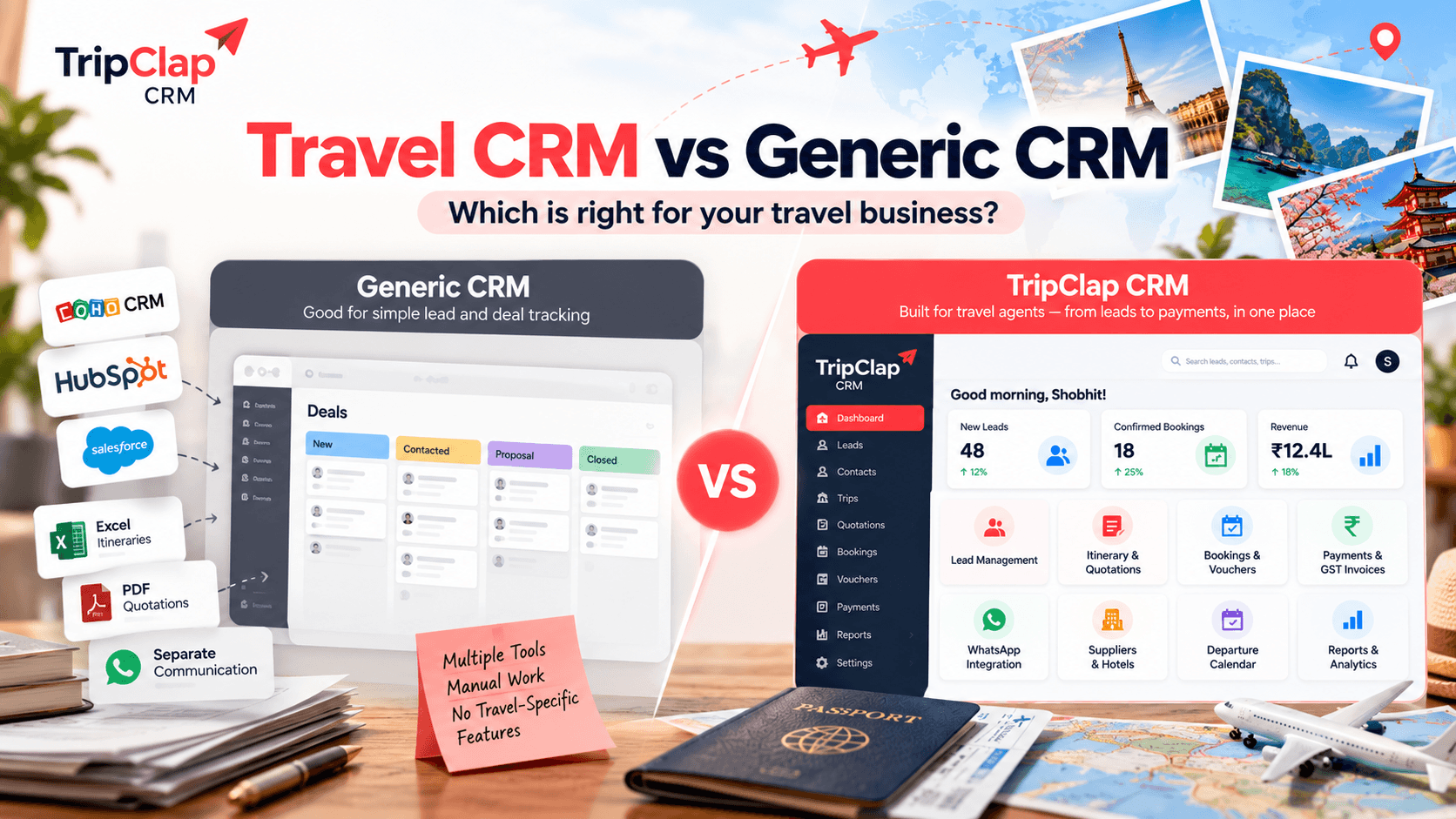
Short answer: Generic CRMs like Zoho and HubSpot can manage travel leads and bookings, but you'll need custom fields, third-party extensions or a developer to add itinerary builders, quotations, vouchers and GST invoices. That setup takes weeks. A travel-specific CRM ships with those features and costs less if you don't already have a Zoho subscription and an in-house admin.
I run TripClap CRM, so I'm not neutral. But I also spent years at HelloTravel using Zoho internally. I've watched dozens of agencies try to bend HubSpot and Salesforce into travel tools.
The question isn't whether generic CRMs are bad. They're excellent. The question is whether you want to spend time and money making them work for travel, or whether you want something that already does.
What a CRM for travel industry needs that Zoho and HubSpot don't ship with
A travel business isn't selling widgets. You're selling itineraries, collecting instalments, issuing vouchers and managing suppliers.
Generic CRMs track leads and deals. They don't know what a day-wise itinerary or a GST invoice looks like.
Itinerary and quotation builder
You need to build a day-by-day plan with hotels, flights, transfers and sightseeing. Then price it, add margins and send a PDF or web link to the customer.
Zoho CRM has no itinerary module. You can build one with Zoho Creator (a low-code app builder) or hire a developer to add custom modules. That's 2 to 4 weeks of work.
HubSpot has no native itinerary tool either. Agencies use Google Docs or a separate quotation tool, then attach the PDF to the deal. You lose the ability to track which itinerary version converted.
Salesforce can do it with custom objects and Visualforce pages, but you'll need a Salesforce consultant.
Booking and voucher management
Once a lead confirms, you need a booking record with traveller names, passport details, flight PNRs and hotel vouchers. You need to send those vouchers to the customer and your suppliers.
Generic CRMs let you create a "Booking" module, but the voucher format and the supplier workflow are on you. Zoho CRM can generate PDFs from templates, but you'll spend hours setting up each template.
Departure calendar and operations
You need a calendar that shows which groups depart when, which bookings have pending vouchers, which cabs are assigned. Ideally it syncs to Google Calendar so your ops team sees it on their phone.
Zoho CRM has a calendar view, but it's designed for sales activities, not departures. You can customise it, but it won't sync departure dates to Google Calendar without a third-party integration.
HubSpot's calendar is similar. It's built for meetings and tasks, not group departures.
GST invoices and payment tracking
You need invoices with your company GSTIN, line items for the tour package, GST breakup and payment terms. Then you need to track instalments, outstanding balances and send payment links.
Zoho Books handles invoicing, and it integrates with Zoho CRM. But it's a separate subscription. You'll map CRM deals to Books invoices manually or with Zoho Flow.
HubSpot has no native invoicing. Agencies use Stripe Invoicing, Zoho Books or a separate accounting tool.
Supplier and vendor database
You work with dozens of hotels, transporters, guides and activity providers. You need their contact details, rate cards, payment terms and booking history in one place.
You can create a "Vendors" module in Zoho CRM or a custom object in Salesforce. But linking vendor records to bookings and tracking what you owe each supplier takes custom workflows.
WhatsApp Business integration
Most travel enquiries come on WhatsApp. You want those conversations inside your CRM, not scattered across your team's personal phones.
Zoho CRM integrates with the official WhatsApp Business API, but only on the Enterprise plan and you'll still need to set up a Meta Business account and pay Meta's per-conversation fees.
HubSpot doesn't have a native WhatsApp integration. You'll use a third-party tool like Wati or Interakt, which costs ₹2,000 to ₹4,000/month on top of HubSpot.
Side-by-side: what you get out of the box
| Feature | Zoho CRM | HubSpot CRM | Salesforce | TripClap CRM |
|---|---|---|---|---|
| Lead capture & pipeline | Yes | Yes | Yes | Yes |
| Itinerary builder | Custom module or Zoho Creator | External tool | Custom Visualforce | Built-in, drag & drop |
| Quotation PDF | Custom template | External tool | Custom template | 3 designs, web link or PDF |
| Booking & vouchers | Custom module + templates | Custom object | Custom object + templates | Built-in |
| Departure calendar | Activity calendar (not for departures) | Activity calendar | Custom calendar | Built-in, syncs to Google |
| GST invoices | Zoho Books (separate) | External tool | Salesforce Billing (add-on) | Built-in |
| Payment links | Zoho Books or custom | Stripe or custom | Custom | Razorpay, Cashfree |
| Supplier management | Custom module | Custom object | Custom object | Built-in |
| WhatsApp Business | Enterprise plan + Meta setup | Third-party tool | Third-party tool | Built-in (Enterprise Elite) |
| AI assistant | Zia (limited to sales insights) | ChatSpot (content & prospecting) | Einstein (add-on, predictive) | Ask questions, draft replies, build itineraries |
| Setup time | 2 to 6 weeks | 1 to 4 weeks | 4 to 12 weeks | 1 day |
Prices checked on vendor websites in October 2026.
How much it costs to make Zoho CRM or HubSpot travel-ready
Let's say you're a 5-person agency. You want lead management, itinerary builder, quotations, bookings, invoices, WhatsApp and reports.
Zoho CRM for travel agency
Zoho CRM Standard is ₹800/user/month (billed yearly). For 5 users that's ₹48,000/year. But Standard doesn't include custom modules, workflow automation or WhatsApp.
You'll need Professional (₹1,400/user/month, ₹84,000/year for 5 users) or Enterprise (₹2,600/user/month, ₹1,56,000/year) to build custom modules and connect WhatsApp.
Then you'll need Zoho Books for invoicing. Standard is ₹2,200/month (₹26,400/year) for 3 users. Add ₹1,100/month for each extra user.
Custom module development: if you hire a Zoho consultant to build an itinerary module, booking module and voucher templates, the cost and timeline will vary by consultant. If you use Zoho Creator to build those modules yourself, add ₹600/month (₹7,200/year) for the Creator subscription, plus 20 to 40 hours of your time.
Total first-year cost for 5 users: ₹1,56,000 (Zoho CRM Enterprise) + ₹26,400 (Zoho Books) + consultant fees. Or ₹84,000 (CRM Professional) + ₹26,400 (Books) + ₹7,200 (Creator) + your time.
Ongoing: ₹1,82,400/year if you stick with Enterprise and Books. Less if you drop to Professional once setup is done.
HubSpot for travel agency
HubSpot's free CRM is genuinely free and works for lead tracking and deal pipelines. But it has no custom objects, no workflow automation and no quotation tool.
HubSpot Sales Hub Professional is USD 90/user/month (roughly ₹7,500/month at October 2026 exchange rates). For 5 users that's ₹4,50,000/year. You get custom objects and workflows, but still no itinerary builder or invoicing.
You'll use a separate quotation tool (PandaDoc, Proposify). You'll use Zoho Books or Stripe Invoicing for GST invoices. You'll use Wati or Interakt for WhatsApp.
Total first-year cost: ₹4,50,000 (HubSpot) + quotation tool + ₹26,400 (Zoho Books) + WhatsApp tool.
HubSpot makes sense if you're already using it for marketing automation and you value its email sequences and reporting. For a small travel agency, it's expensive.
Salesforce
Salesforce Essentials starts at USD 25/user/month (₹2,100/month, ₹1,26,000/year for 5 users), but it's limited to 10 users total and doesn't include custom objects.
Sales Cloud Professional is USD 80/user/month (₹6,700/month, ₹4,02,000/year for 5 users). You get custom objects, but you'll need a Salesforce consultant to build your itinerary and booking modules.
Total first-year cost: ₹4,02,000 + consultant fees.
Salesforce is overkill unless you're a large DMC with complex sales processes and an in-house Salesforce admin.
When a generic CRM is the right choice
I'm not saying Zoho or HubSpot is wrong for travel. It depends on your situation.
You should use Zoho CRM if:
- You're already on Zoho One (the all-apps bundle at ₹4,200/month for unlimited users). You get CRM, Books, Creator and everything else. The marginal cost of adding travel workflows is just your time or a consultant's fee.
- You have an in-house admin who knows Zoho and can maintain custom modules. Once the setup is done, it runs well.
- You need deep customisation that a travel CRM doesn't offer. For example, you run a visa processing business alongside tours, or you have a multi-brand holding company with complex commission splits.
You should use HubSpot if:
- You're already paying for HubSpot Marketing Hub and you want your sales and marketing data in one place. The cost of Sales Hub is easier to justify.
- You do a lot of inbound content marketing and you value HubSpot's email workflows, landing pages and analytics.
- You're okay using separate tools for itineraries and invoicing, and you just want HubSpot to track the deal pipeline.
You should use Salesforce if:
- You're a large DMC or tour operator with 50+ employees, complex approval workflows and integrations with your own booking engine.
- You already have a Salesforce admin on staff.
- You need enterprise-grade security, compliance and audit trails.
When a travel-specific CRM makes more sense
If you're a travel agent or small tour operator and you don't already have a Zoho subscription or a CRM admin, a travel-specific CRM costs less and works faster.
TripClap CRM's Pro Plus plan is ₹19,999/year (about ₹1,667/month) for 10 users. You get lead management, itinerary builder, quotations, bookings, vouchers, invoices, payment links, vendor management and reports. No setup fee. No consultant. You're live in a day.
The Enterprise Elite plan is ₹24,999/year (₹2,083/month) and adds WhatsApp Business on the official Meta Cloud API, unlimited users and payment schedules.
Compare that to ₹1,17,600/year for Zoho Professional plus Books plus Creator, and your time building modules.
The trade-off: you give up some flexibility. TripClap CRM doesn't have Zoho's 40+ apps or HubSpot's marketing automation. It does one thing, travel sales and operations, and it does it without customisation.
For a detailed feature comparison, see TripClap vs Zoho CRM.
What about free CRM options?
HubSpot's free CRM is solid for lead tracking. You can use it alongside Google Sheets for itineraries and Zoho Books free (up to ₹5 lakh revenue/year) for invoicing.
That works if you're a solo agent doing 2 or 3 bookings a month. Once you have a team and you're doing 10+ bookings a month, the manual copy-paste between tools eats more time than the CRM subscription costs.
I covered this in more detail in Travel CRM vs Excel.
Setup time: what agencies actually experience
I've talked to agencies who moved from Excel to Zoho, from Zoho to TripClap, and from HubSpot to a travel CRM. Here's what the setup timeline looks like in practice.
Zoho CRM: 2 weeks if you're just doing lead management and using Zoho's standard fields. 4 to 6 weeks if you're building custom modules for itineraries and bookings. Add another 2 weeks to train your team and migrate data from Excel or your old CRM.
HubSpot: 1 week for basic lead tracking. 3 to 4 weeks if you're setting up custom objects for bookings and connecting third-party tools for quotations and WhatsApp.
TripClap CRM: Half a day to import leads and set up your team. One more day to build your first itinerary template and connect Razorpay. Most agencies are running live bookings by day three.
A real example: 8-person agency in Jaipur
A DMC I know in Jaipur was using Zoho CRM Standard. They tracked leads fine, but they were building itineraries in Word, sending PDFs on WhatsApp, and tracking payments in Excel. Invoices were in Zoho Books, but the ops team never logged in, so they didn't know which bookings had pending vouchers.
They gave up, moved to TripClap CRM and were live in 2 days. First-year cost: ₹24,999 for Enterprise Elite (they wanted WhatsApp). They saved on the Zoho Professional subscription and consultant fees.
They still use Zoho Books for accounting because their CA prefers it, and TripClap CRM's invoices export to Books with one click.
Integrations: where generic CRMs have an edge
Zoho and HubSpot integrate with hundreds of tools. If you use Mailchimp for email marketing, Calendly for demo bookings, Slack for team chat and Stripe for payments, you can connect all of them.
TripClap CRM integrates with the tools travel agencies actually use: Facebook Lead Ads, Google Ads, Typeform, Razorpay, Cashfree, Gmail, Google Calendar, Zapier, n8n and webhooks. If you need something custom, you can build it with Zapier or n8n.
But TripClap doesn't have a native Mailchimp integration or a Slack bot. If those matter to you, Zoho or HubSpot is a better fit.
What you lose with a travel-specific CRM
I'll be honest about where TripClap CRM falls short.
No built-in phone dialer or call recording. Zoho CRM integrates with Zoho PhoneBridge and third-party dialers. TripClap CRM doesn't. You'll use your mobile or a separate dialer.
No marketing automation. HubSpot's email sequences, landing pages and A/B testing are excellent. TripClap CRM doesn't do any of that. You'll use Mailchimp, Brevo or another email tool.
Limited reporting customisation. Zoho and Salesforce let you build any report you can imagine. TripClap CRM's reports cover the metrics travel agencies track (leads, conversions, revenue, payments, team performance), but you can't build a custom pivot table or a funnel report.
No multi-currency accounting. If you're a large outbound operator billing in USD, EUR and INR, you'll need Zoho Books or Xero for proper multi-currency accounting. TripClap CRM's invoices and payment tracking are INR-only.
How to decide: a checklist
Here's how I'd think about it if I were starting a travel agency today.
- Do you already pay for Zoho One or HubSpot Marketing? Yes: Use Zoho CRM or HubSpot and add travel workflows. No: Keep reading.
- Do you have an in-house CRM admin or a developer on retainer? Yes: Zoho or Salesforce will give you more control. No: A travel CRM saves you the consultant cost.
- Do you do fewer than 10 bookings a month? Yes: HubSpot free CRM plus Google Sheets might be enough. No: You need a proper CRM.
- Do you need deep customisation (multi-brand, complex commissions, custom approval flows)? Yes: Zoho or Salesforce. No: A travel CRM covers 90% of agencies.
- Do you want to start selling this week, not next month? Yes: A travel CRM is faster.
If you want the bigger picture first, read our travel-specific CRM.
and for more details, read our travel CRM guide.
Frequently asked questions
Can I use Zoho CRM free edition for a travel agency?
Zoho CRM free edition supports up to 3 users and includes basic lead and deal management. You can track enquiries and bookings, but you won't get custom modules, workflow automation, email integration or API access. You can't build an itinerary module or connect WhatsApp. It works for a solo agent doing 2 or 3 bookings a month, not for a team.
Does HubSpot CRM work for travel agencies in India?
HubSpot CRM works well for lead tracking and deal pipelines. But it doesn't have a built-in itinerary builder, GST invoicing or WhatsApp integration. You'll need third-party tools for those, which adds cost. HubSpot is a good choice if you're already using HubSpot Marketing Hub and you value the unified reporting.
Is Salesforce worth it for a small travel agency?
No. Salesforce is built for large enterprises with complex sales processes and dedicated admins. The licensing cost starts at ₹4,02,000/year for 5 users on Sales Cloud Professional, and you'll spend more on a consultant to build your travel workflows. Unless you're a DMC with 50+ employees, Salesforce is overkill.
What's the difference between generic CRM vs travel CRM?
A generic CRM tracks leads, contacts, deals and tasks. It's built for any industry. A travel CRM adds itinerary builders, quotation PDFs, booking management, vouchers, GST invoices, supplier databases and departure calendars. You can build those features into a generic CRM with custom modules and third-party tools, but it takes weeks and costs more than a travel CRM subscription.
Can I migrate from Zoho CRM to TripClap CRM?
Yes. Export your leads, contacts and deals from Zoho CRM as a CSV file and import them into TripClap CRM. Custom fields and notes come across as plain text. You'll need to rebuild your itineraries and quotations in TripClap's builder, but most agencies finish the migration in 2 or 3 days.
Which CRM has the best WhatsApp integration for travel agencies?
Zoho CRM integrates with the official WhatsApp Business API on the Enterprise plan, but you'll still need to set up a Meta Business account and connect it yourself. HubSpot doesn't have a native WhatsApp integration; you'll use a third-party tool like Wati or Interakt. TripClap CRM includes WhatsApp Business on the Enterprise Elite plan, and the setup is done for you.
My honest take
If you're already paying for Zoho One or you have a CRM admin on your team, stick with Zoho CRM. The investment in custom modules pays off because you control everything.
If you're starting fresh and you just want to capture leads, build itineraries, collect payments and manage bookings, a travel-specific CRM costs less and works faster. You'll be live this week, not next month.
I've seen agencies wait weeks for custom modules that don't meet their needs. That's not a Zoho problem. It's a setup problem. For more context, see Best Travel CRM Software in India.
If you want to try TripClap CRM, start the 7-day free trial. No credit card, no consultant, no 6-week wait.
About the author: GG is the founder and CEO of TripClap, which runs a family travel marketplace and TripClap CRM for travel businesses. He has 18+ years of experience building travel and SaaS products, including at IndiaMart’s HelloTravel, and holds an MBA from IIM Lucknow. Connect on LinkedIn.