October 26, 2026
Travel Agency Software vs Travel CRM: What's the Difference?
Most people use "travel agency software" and "travel CRM" interchangeably. They're not the same thing, and getting this wrong costs you time and money.
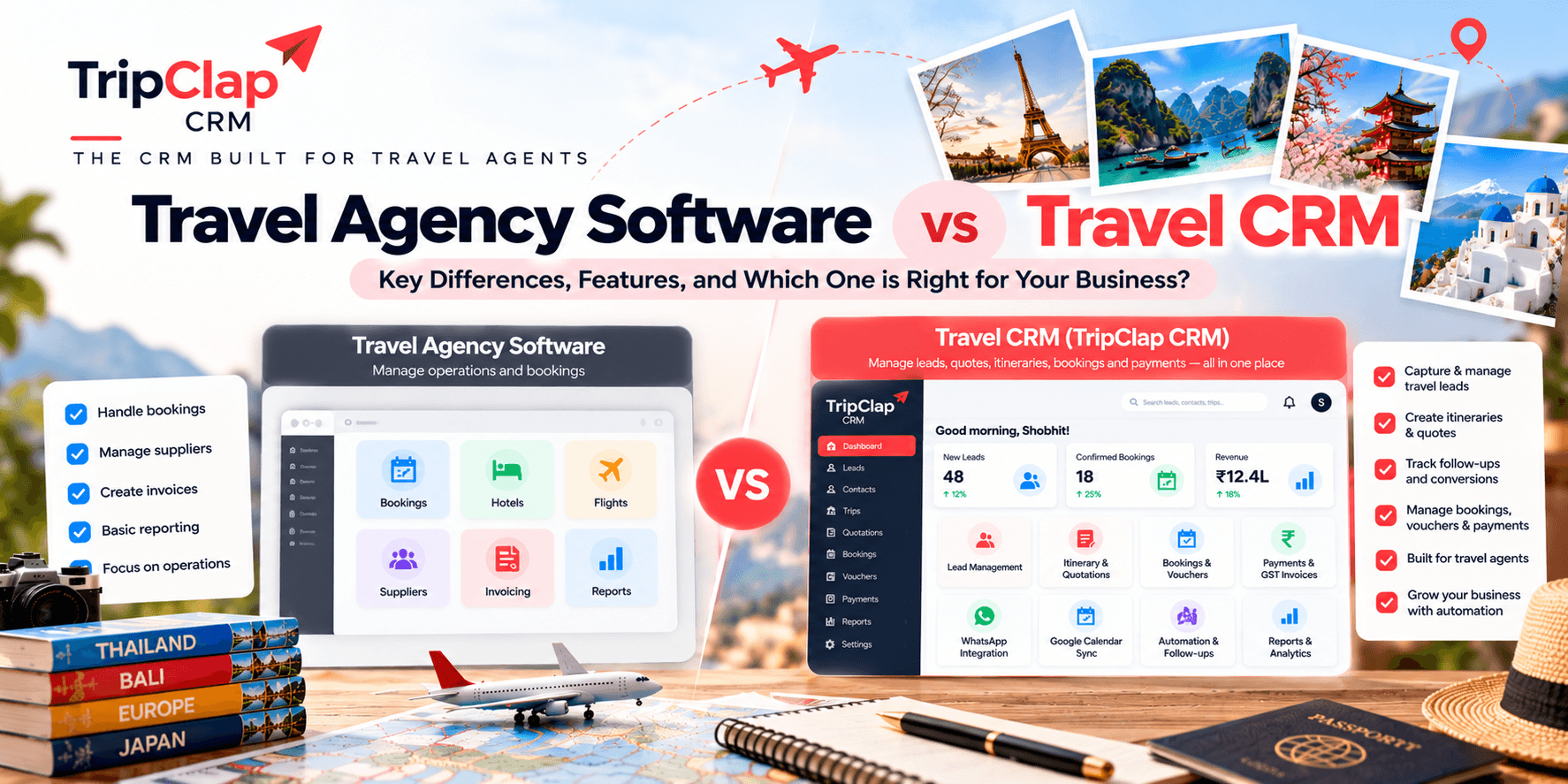
Short answer: Travel agency software usually means a booking engine or B2B portal for live inventory. A travel CRM manages enquiries, itineraries, customers and follow-ups. Most small agencies working on custom tours need the CRM first, because 80% of your day is converting leads, not booking inventory.
I'm the founder and CEO of TripClap CRM. Before that I spent 18+ years building travel and SaaS products, including at IndiaMart's HelloTravel.
Then they still track leads in Excel and send quotations as Word files on WhatsApp.
The confusion comes from the fact that "travel agency software" covers four different things.
What people mean when they say travel agency software
When an agent says they need travel agency software, they usually mean one of these:
1. Booking engine (or GDS/aggregator access)
Live inventory from airlines, hotels, car rentals and activities. You search, book and issue tickets from one portal. Examples: Amadeus, Sabre, TBO Holidays, RateHawk, Travomint.
2. B2B portal or white-label platform
A supplier's system that lets you search their packages and inventory, mark up the price, and send a booking link to your customer. Your brand, their backend. Common in bus ticketing (redBus B2B), hotels (Booking.com for Business), or tour packages.
3. Back-office or accounting software
Tools that handle invoices, GST returns, payment reconciliation, supplier settlements and general ledger. Tally is the most common example. Some travel-specific back-office systems add voucher printing and manifest management.
4. Travel CRM
Software that manages your sales process: lead capture, pipeline, follow-up reminders, itinerary and quotation builder, customer profiles, bookings, payments and reports. This is what is travel CRM software actually does.
All four are "travel agency software" in the broad sense. But they solve completely different problems.
How these tools connect across the booking lifecycle
Here's the typical flow for a custom tour enquiry:
Enquiry stage (CRM territory)
A lead comes in from Facebook, your website, or a WhatsApp message. You log it, ask questions, understand the budget and dates. You create an itinerary with hotels, flights, sightseeing and transfers. You send a quotation. You follow up three times over two weeks.
Booking stage (CRM + booking engine)
The customer confirms. You collect an advance payment. Now you go to your booking engine or B2B portal to book the actual flights and hotels. You get confirmation numbers.
Operations stage (CRM + back-office)
You create vouchers for the customer and send them before departure. You track the final payment. After the trip, you settle with your suppliers. You record everything in your accounting software for GST filing.
The CRM is the only tool that touches every stage. The booking engine only matters when you actually book. Back-office only matters for accounting and compliance.
Do I need a booking engine or a travel CRM first?
It depends on your business model.
You need a booking engine first if:
- You sell mostly flights, hotels or buses as standalone products.
- Customers expect instant confirmation and e-tickets.
- You compete on price and speed, not customisation.
- You're a retailer of commodity inventory.
Flight ticketing agents and hotel-only agencies fall into this category. For them, a GDS or aggregator API is the core product.
You need a CRM first if:
- You sell custom tour packages or group departures.
- Most enquiries need a personalised itinerary and quotation.
- You spend more time following up and negotiating than you do booking.
- Your competitive advantage is service, local knowledge or unique itineraries.
This is most leisure travel agents, inbound tour operators and DMCs. Your real bottleneck is not booking inventory. It's converting leads.
The problem is not that booking a hotel takes 10 minutes.
The problem is that 12 of those 15 leads never got a quotation, or got it four days late, or the follow-up reminder was buried in WhatsApp.
A travel CRM fixes that. A booking engine does not.
When you need both (and in what order)
Once your sales process is organised and you're converting 20% to 30% of enquiries, a booking engine makes sense.
At that point you're doing enough volume that manually emailing hotels and waiting for confirmations becomes the bottleneck. Live inventory saves you hours per booking.
But get the CRM working first.
Here's a simple decision tree:
| Your situation | Start with | Add later |
|---|---|---|
| Under 50 enquiries a month, mostly custom tours | CRM | Booking engine when you're doing 15+ bookings/month |
| 50 to 150 enquiries a month, mix of packages and FIT | CRM | Booking engine within 6 months |
| Mostly flights, hotels, buses sold individually | Booking engine or B2B portal | CRM if you add packages later |
| High-volume corporate travel or MICE | CRM + booking engine together | Dedicated back-office for reconciliation |
What about travel management software or tour operator software?
These are just marketing phrases for the same categories.
"Travel management software" usually means one of two things: corporate travel booking tools (for companies managing employee trips) or an all-in-one system that combines CRM, booking engine and back-office. The all-in-one systems are expensive and take months to implement.
"Tour operator software" usually means a CRM with strong itinerary building, costing and operations features. That's what we built TripClap CRM to be.
Don't get distracted by labels. Ask: does this tool help me capture more leads, convert them faster, and deliver trips without mistakes? If the answer is no, you don't need it yet.
A worked example: small agency with 3 people
Let's say you run a leisure travel agency in Jaipur. You and two sales staff. You get 60 enquiries a month from Facebook Ads, your website and referrals. You close about 12 to 15 bookings. Average booking value ₹1.2 lakh. Most trips are to Kerala, Goa, Himachal, Dubai and Thailand.
What you need today:
- A travel CRM to capture Facebook leads automatically, assign them to your team, build itineraries and quotations, set follow-up reminders, and track payments.
- WhatsApp Business (ideally integrated with the CRM) so you can send quotations and updates without juggling two apps.
- A Razorpay or Cashfree account to collect advance payments online.
What you don't need yet:
- A booking engine. You're doing 12 to 15 bookings a month. You can email hotels and book flights on airline websites or through a local consolidator. It takes 20 minutes per booking. That's 5 hours a month. Not your bottleneck.
- Dedicated back-office software. Your CA handles Tally and GST. You're not reconciling 500 supplier invoices a month.
What you add in 12 months:
If you grow to 25 to 30 bookings a month, get API access to a hotel aggregator like RateHawk or TBO. Plug it into your CRM if possible, or just use it separately for booking. You'll save 2 to 3 hours per day.
Where TripClap CRM fits (and where it doesn't)
I'm obviously biased, but I'll be straight about what we do and don't do.
TripClap CRM is a sales and operations CRM for travel agents, tour operators and DMCs. It handles lead capture (including auto-capture from Facebook and Google Ads), pipeline, itinerary builder, quotations, bookings, vouchers, payments, customer profiles, supplier management and reports. We also have an AI assistant that drafts itineraries and answers questions in English, Hindi and Hinglish.
We integrate with Razorpay and Cashfree for payment links. On the Enterprise Elite plan, you get WhatsApp Business on the official Meta Cloud API, so conversations happen inside the CRM.
Plans start at ₹14,999 a year (about ₹1,250 a month) for 3 users. You can start the 7-day free trial without a credit card.
Where TripClap CRM falls short:
- We don't have a built-in booking engine. If you need live flight or hotel inventory, you'll use a separate GDS or API and then log the booking in TripClap.
- We don't have a phone dialler or call recording. If your team makes 100 calls a day and you need call tracking, you'll need a separate tool or a more expensive platform.
- We're not a full accounting system. You can track payments and generate GST invoices, but for ledger, P&L and tax filing you'll still use Tally or your CA's software.
That's by design. We built a CRM that does one thing really well: help you convert more enquiries into bookings and run operations without chaos. If you also need live inventory or advanced accounting, you add those tools separately.
For a comparison with generic CRMs like Zoho or Salesforce, see our article on travel CRM vs generic CRM. If you want to compare other India-focused travel CRMs, we have a guide to the best travel CRM software in India.
Frequently asked questions
Can I use a travel CRM if I also sell flights and hotels individually?
Yes. You log the enquiry in the CRM, create a simple quotation (or just a line-item invoice), book the flight in your GDS or aggregator portal, then record the booking and payment back in the CRM. The CRM keeps the customer record and payment trail even if the actual booking happens elsewhere.
Do I need a separate CRM if my booking engine has a "lead management" module?
Most booking engines have very basic lead capture, just a form and a list. They don't have pipeline stages, follow-up reminders, itinerary builders, or proper reporting. If 80% of your business is custom packages, you'll outgrow that module in a month. Get a real CRM.
What's the difference between travel booking software and travel CRM?
Travel booking software usually means a system that connects to live inventory (flights, hotels, cars) and lets you search, book and issue tickets. A travel CRM manages the sales process: enquiries, quotations, follow-ups, customers and bookings. Booking software is transactional. CRM is relational.
Can a travel agency run without any software at all?
Yes, if you're doing under 5 bookings a month and all your customers are referrals. Beyond that, you'll spend half your day hunting for old WhatsApp messages and wondering who you forgot to follow up. Software pays for itself in saved time and fewer missed leads.
Should I get an all-in-one travel ERP or separate tools?
All-in-one ERPs (CRM + booking + accounting + inventory) take months to implement and cost several lakhs a year. For everyone else, start with a CRM and add booking and accounting tools as you grow.
How do I know when I've outgrown Excel and WhatsApp?
When you forget to follow up on a lead because the reminder was buried in messages. When you send the same customer two different quotes because you lost track. When you can't answer "how many Kerala enquiries did we get last month?" without scrolling for 20 minutes. That's the day you need a CRM.
My honest take
Most agents buy software in the wrong order because they think automation means booking inventory faster.
It doesn't. It means spending less time on repetitive work and more time talking to customers.
If you're doing custom tours and your conversion rate is under 20%, your problem is sales process, not booking speed. Get a CRM, use it properly for three months, and watch your conversions go up. Then, if booking is still taking too long, add a booking engine.
If you want to see what a proper travel CRM looks like, start the 7-day free trial of TripClap CRM. No credit card, no sales call unless you ask for one.
About the author: GG is the founder and CEO of TripClap, which runs a family travel marketplace and TripClap CRM for travel businesses. He has 18+ years of experience building travel and SaaS products, including at IndiaMart’s HelloTravel, and holds an MBA from IIM Lucknow. Connect on LinkedIn.